
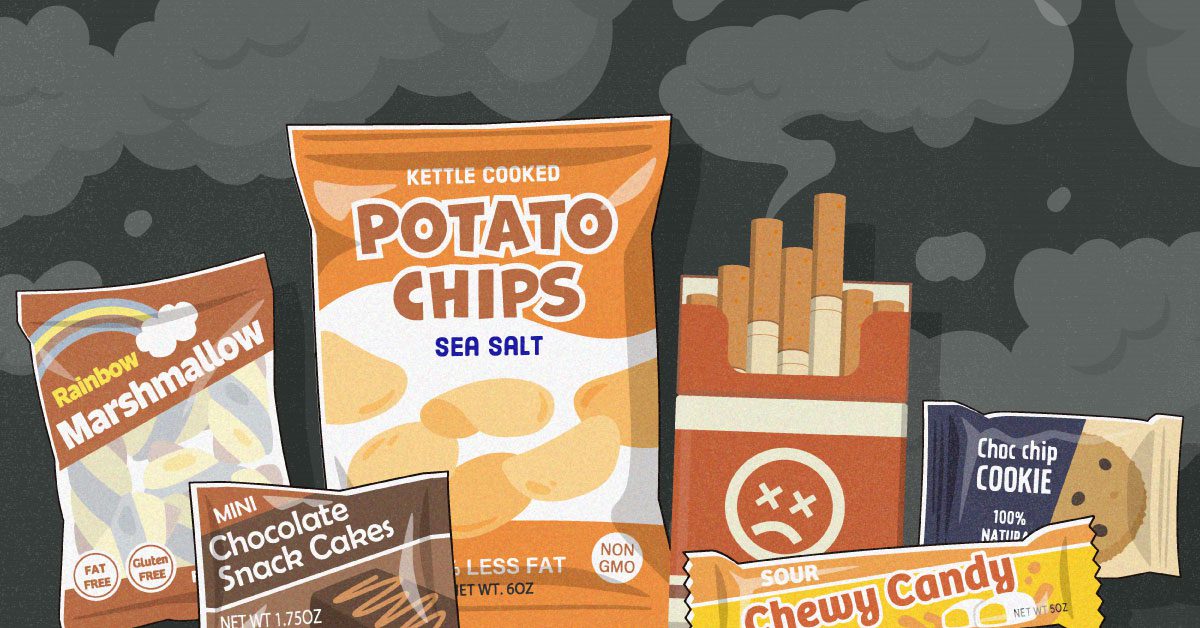
What do cigarettes and store-bought cookies have in common? More than you might think. The companies that keep tobacco and nicotine on shelves today once controlled some of America’s favorite food brands. And while chips and candy don’t carry a warning label like tobacco products, these companies’ influence on what we eat isn’t something most people realize.
In the 1980s and 90s, tobacco giants like Philip Morris and R.J. Reynolds expanded into the consumer goods market. Philip Morris bought Kraft and General Foods; R.J. Reynolds owned Nabisco. These companies brought the same marketing playbook that addicted so many to their tobacco products into America’s kitchen pantries.
Why Big Tobacco Went Into the Snack Game
By the late 1970s, tobacco companies were facing a storm. Smoking rates were falling, health warnings were growing louder and regulations were tightening. To keep profits strong, the industry started looking for new businesses where its marketing tactics could replicate the same success — and food was the perfect fit.1
The grocery store shelves of the 1980s were battlegrounds for convenience and taste. Americans wanted quick meals and snacks that delivered instant gratification, and Big Tobacco’s leaders knew exactly how to exploit that demand. Their experience engineering consumer behavior — from brand loyalty to habit formation — translated neatly from cigarettes to cookies, crackers and powdered drinks. They began to dominate these products that were also built around daily consumption.
Finding the “Bliss Point”
Tobacco companies knew sensory experience mattered — and developed the precise combinations of sugar, salt and fat that would light up the brain’s reward centers. 2
Those “bliss point” recipes were engineered to keep people coming back for more, the same way a cigarette’s chemical balance was designed to keep smokers addicted.3
It worked. By the early 2000s, the brands owned by tobacco companies dominated the processed-food market. The same precision that once kept smokers hooked was now driving Americans to reach for chips, cookies and quick-fix meals.
The Science of Snack Addiction
When researchers looked back at food products made by tobacco-owned companies between 1988 and 2001, they found something striking: those foods were significantly more likely to be “hyper-palatable.”3 That means they contained combinations of ingredients — especially salt, refined carbs and fats — that triggered the brain’s pleasure response and encouraged overeating. These foods were fine-tuned to make moderation difficult.
A few chips turn into half the bag. One cookie becomes 10. That’s not a coincidence. For years, companies studied how to make foods people would reach for again and again.
As one researcher put it, “The same methods that made cigarettes addictive were used to make food irresistible.”1
The Obesity Crisis Emerges
As tobacco playbooks migrated from cigarettes to snacks, the same engineering of craving helped fuel a dramatic rise in obesity across the United States. Ultra-processed, hyper-palatable foods — formulated for maximum reward — became staples of daily eating, shifting calories toward cheap, convenient products and away from whole foods.
Today, more than half of the calories consumed by Americans come from ultra-processed foods.4 These products are convenient, cheap and everywhere — from vending machines to drive-thrus. They’re designed to taste amazing, travel well and last longer on shelves.
Among children and adolescents, obesity rose sharply, roughly tripling from about 5% in the late 1970s to around 15% by the 1990s, leaving a generation more likely to experience obesity into adulthood. Aggressive, targeted marketing normalized frequent consumption, especially in communities already burdened by health disparities and these tactics entrenched these new eating patterns.
Obesity continued to climb through the 2000s and 2010s, driven by persistent availability of ultra-processed foods, ongoing industry marketing and environments that favor convenience over nutrition. By 2017–2018, the adult obesity rate reached 42.4%, a marked increase from earlier decades.
Marketing, Communities and the Snack Shift
Of course, effective marketing requires skill — and that was something Big Tobacco had in abundance. These companies brought decades of branding expertise to the food world, targeting kids, families and cultural groups in ways that felt familiar.
For example, Kraft (owned by Philip Morris at the time) created new Kool-Aid flavors to market to Hispanic consumers. The company also used community events to distribute samples and coupons to Black families.2 While these promotions were framed as outreach, they reflected the same micro-targeted marketing tactics that once sold cigarettes to specific communities.
Colorful ads, cartoon mascots and catchy slogans made their way from cigarette billboards to cereal boxes and snack commercials.3 Food advertising became omnipresent, shaping tastes and normalizing processed foods as everyday staples. The impact mirrored tobacco’s legacy: deeply ingrained habits that proved hard to break.
The Legacy on Your Plate Today
Even after tobacco companies divested from food in the early 2000s, the strategies they pioneered stuck around. The industry had already learned how to optimize for craving and convenience, and competitors continued to follow that model.3
The problem? They also make it harder to eat balanced meals. Studies link high consumption of ultra-processed foods to increased risks of obesity, heart disease and certain cancers.5 And just like cigarettes in decades past, they’ve become deeply woven into everyday routines.
It’s easy to see echoes of Big Tobacco’s playbook in modern food marketing: the emotional appeals, the bright packaging, the idea that happiness comes in a convenient, perfectly flavored package.
Taking Back Control
The good news? We can take that power back.
Understanding how these industries shaped our habits doesn’t mean we have to feel guilty — it means we can make informed choices. Every small step counts: swapping soda for water, filling half your plate with fruits and veggies and reducing or quitting tobacco use.
Our environments are powerful, but so are we. The more we know about how these products are designed, the easier it becomes to make choices that serve our long-term health instead of short-term cravings.
For practical tips, simple swaps and recipes that make healthy eating easier, visit Shape Your Future. Because when you know the playbook, it’s a lot easier not to fall for the same old tricks.
Sources
- Many of Today’s Unhealthy Foods Were Brought to You by Big Tobacco – The Washington Post.
- How America Got Hooked on Ultra-Processed Foods – New York Times
- Tobacco-Owned Food Companies and Hyper-Palatable Foods – University of Kansas
- Ultra-Processed Foods and Added Sugars in the U.S. Diet – BMJ Open
- Ultra-Processed Diets Cause Excess Calorie Intake and Weight Gain – Cell Metabolism