
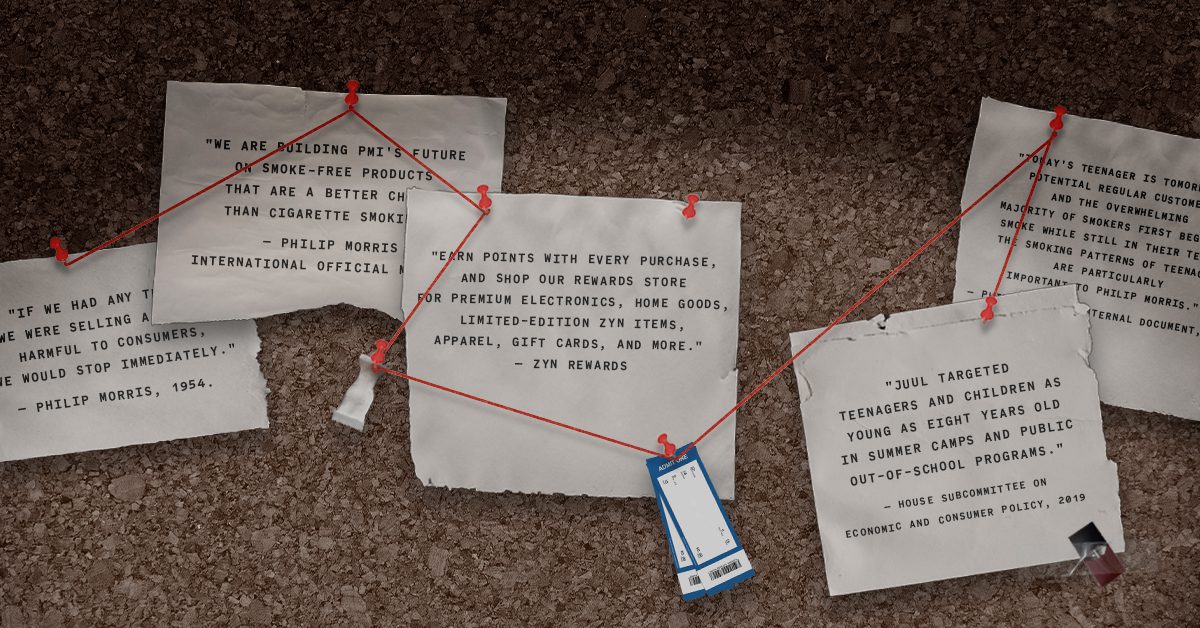
Here are a few of their quotes:
On Health: Then and Now
“If we had any thought or knowledge that in any way we were selling a product harmful to consumers, we would stop business immediately.”
— Philip Morris VP George Weissman, 1954 1
“We are building PMI’s future on smoke-free products that are a better choice than cigarette smoking.”
— Philip Morris International official mission
Seventy years separate those two quotes. In the time between them, cigarettes killed more than 20 million Americans. They caused lung cancer, heart disease and stroke on a massive scale, while the tobacco companies simply chose to brush it under a rug and lie to the public.
Now Philip Morris is making the same promise about a new set of products. The problem is we are still in the early days of vapes and nicotine pouches. Long-term studies do not exist yet, but even recent studies have revealed harmful, permanent effects. What we do know is that nicotine pouches have been linked to gum disease, increased heart rate and cardiovascular damage, vaping has been connected to serious lung injuries, and nicotine itself is highly addictive regardless of how it is delivered. While cigarettes remain the most harmful, the problem with new products is initiation. Kids who would likely never reach for cigarettes are starting to use vapes and pouches, and those kids are 7x more likely to smoke later in life. 2
Philip Morris said not to worry in 1954. They are saying the same thing now, but this time we’re all wiser and won’t be fooled again.
On Youth: Then and Now
“Today’s teenager is tomorrow’s potential regular customer, and the overwhelming majority of smokers first begin to smoke while still in their teens. The smoking patterns of teenagers are particularly important to Philip Morris.”
— Philip Morris internal document, 1981 3
“JUUL targeted teenagers and children as young as eight years old in summer camps and public out-of-school programs.”
— House Subcommittee on Economic and Consumer Policy, 2019 4
Decades apart, the tobacco industry has the same business model hiding in plain sight. Philip Morris called teenagers their most important customers in 1981. By 2019, a congressional investigation found JUUL had taken that philosophy further than anyone had publicly admitted, reaching children in the places they were supposed to be safest.
The modern tactics for targeting youth are more subtle, but no less deliberate. Flavors are the most obvious example. Nearly 90% of middle and high school students who vape use flavored products. Fruit, candy and mint top the list, all flavors made to make nicotine taste like something a teenager already enjoys.
Social media has replaced the billboard for youth audiences. Tobacco marketing now lives on TikTok and Instagram, pushed by influencers and user content that often does not look like advertising at all. Videos from so-called “Zynfluencers” have racked up tens of millions of views, and in almost every setting the product is falsely described as “totally safe.”
Young people have always been the target. The only thing that changed was how well the industry learned to hide it.
On Marketing: Then and Now
“The brand loyalty of 18-year-old smokers far outweighs any tendency to switch with age. Younger adult smokers are the only source of replacement smokers. If younger adults turn away from smoking, the industry must decline, just as a population which does not give birth will eventually dwindle.”
— R.J. Reynolds internal document, 1984 5
“Earn points with every purchase, and shop our rewards store for premium electronics, home goods, limited-edition ZYN items, apparel, gift cards, and more.”
— ZYN Rewards
An R.J. Reynolds executive wrote that quote in 1984. Four decades later, Philip Morris, the parent company of ZYN, is handing out iPads and concert tickets. Addiction packaged under the guise of “brand loyalty” is still the mission.
Loyalty programs are not new to the tobacco industry. In the 1990s, cigarette users could trade empty packs for camping gear, and Camel printed fake dollar bills inside packs redeemable for branded merchandise. The more you smoked, the more you earned. The 1998 Master Settlement Agreement eventually forced those programs to shut down.
ZYN picked up right where they left off: Scan a can, collect points. In April 2025, ZYN offered exclusive tickets to a Noah Kahan concert through their rewards program. To qualify, fans needed to buy at least 200 tins of ZYN, roughly $2,000 worth of nicotine pouches. The prize is different. The strategy is the same.
What the Paper Trail Proves
Big Tobacco has never been caught off guard. Every new product category, from filters to lights to vapes to nicotine pouches, has followed the same arc: launch with health-adjacent language, deny the risks, target the young, and wait out the regulators.
Then do it again with something new.
Big Tobacco is not reinventing itself; it is counting on you to think it is. Every sleek new device, every fruit flavor, every rewards point and concert ticket is part of a system that has been running for decades. It’s up to us to stop it.
Sources
- ASH.org — Open Letter to PMI From 123 Organizations
- Science Direct – Addictive Behaviors Volume 2: Association between e-cigarette use and future combustible cigarette use: Evidence from a prospective cohort of youth and young adults
- PHCC.org — How the Tobacco Industry Targets Young People To Achieve a New Generation of Smokers
- The Truth Initiative — Examining JUUL’s Role in the Youth E-Cigarette Epidemic
- Campaign for Tobacco-Free Kids — Tobacco Company Quotes on Marketing to Kids